
Welcome to Phil Aaronson's blog.
rss,
flickr,
twitter,
linkedin,
facebook,
feedfriend
2009-05-13 06:31AM PDT/Home
Phil Aaronson
I bought my first Kindle edition of a book,
The Alchemyst
last night. I use my iPod Touch to read the girls their bedtime story. With it I can turn off the lights and let them drift off to sleep, but still be able to read the screen. I read the sample first couple of chapters, and it really sucked in my oldest so we bought the rest. I'll update this once we finish the book, we left off last night with this paragraph.
“Dee and the Dark Elders he serves will remake this world as it was in the unimaginably ancient past. And the only place for humans in it will be as slaves. Or food.”
My oldest looked at me and said, "I don't want to be food." And then smiled and rolled over and went to sleep.
2009-04-16 10:05AM PDT/Work
Phil Aaronson
A nice little article from Mac Rumors on Apple's patent application for adjusting a graphical interface if the device detects that it's in motion. The example they used was making the interface buttons and targets larger if the device (the iPhone) detects that the user is out running.
I wonder if Apple has considered similarly adjusting the iPhone's GUI for people with big fingers, or the elderly and disabled who have degraded motor control. Still, adapting GUIs to the conditions they're in is a great idea.
2009-04-13 03:02PM PDT/Work
Phil Aaronson

2009-04-09 12:57PM PDT/Work
Phil Aaronson
Recently I created the flickr group Failure Mode. With three kids, I seem to be the designated fix it guy around the house, so I thought I'd try to motivate myself to take pictures of how things fail. Join on in, I'm still trying to come up with a group icon.
2009-04-06 10:55AM PDT/Work
Phil Aaronson
I don't remember if this was the exact
article, but I think it was.
Isn't “hinkty” a great word? It describes perfectly a style, or style of life, that's embarrassingly unfashionable. Tom Wolfe used it once to refer to men's shirts that don't have that little button on the back of the collar — do they anymore? — and if you listen carefully, you can hear one of the policemen in the movie “The Fugitive” saying it. Hinkty — a total killer.
Ah, a style of life that is embarrassingly unfashionable. That suited me perfectly.
2009-04-05 12:31PM PDT/Home
Phil Aaronson
There's an interesting inflection point for Google, and to a lesser extent all search engines, Yahoo! included (disclaimer: where I'm employed). My posited inflection occurs when the value of a piece of content appearing in Google's index equals the value of the traffic that Google sends to view that content, and the publisher realizes it. Go past the inflection point, and the situation becomes unstable. When publishing content is worth more to Google, or Yahoo! or any search engine, than to the publisher itself, sooner or later they'll want to be properly compensated.
That's what I was thinking of as I read Google is just an amoral menace. Here's a choice quote:
… what we are seeing is a much older and toxic capitalist model - the classic monopoly that destroys industries and individual enterprise in its bid for ever greater profits. Despite its diversification, Google is in the final analysis a parasite that creates nothing, merely offering little aggregation, lists and the ordering of information generated by people who have invested their capital, skill and time.
I've been waiting for this point, and have started to see hints we're almost on top of it. The question then becomes, well, what happens next?
I think the next logical step is for newspapers and publishers to start charging to allow their content to be indexed. A mechanism for excluding index programs already exists. It's what a robots.txt file is for, and it's very straightforward. Going a little further along this line of thought, one could imagine automating the robots.txt file across hundreds of publishers creating much larger leverage. Going even further and one could imagine publishers themselves interfacing directly with search engines, controlling how their content gets indexed and creating a marketplace for their content.
In this future marketplace, a publisher and indexer could negotiate and possibly indexer bid over what keywords a piece of content is allowed to be indexed under. A higher quality (to the publisher) traffic generating keyword, but low advertising value keyword might be very cheap for a search engine to purchase. A lower quality traffic generating, higher ad value keyword might be much much more expensive.
Update: Another data point, Robert Thomson the editor of the Wall Street Journal is quoted in The Austrailian
“Google argues they drive traffic to sites, but the whole Google sensibility is inimical to traditional brand loyalty,” he said.
“Google encourages promiscuity — and shamelessly so — and therefore a significant proportion of their users don't necessarily associate that content with the creator.”
“Therefore revenue that should be associated with the creator is not garnered.”
While he understands that the value is now residing in Google's index and not with the publisher, he mentions e-readers as a possible solution. Unfortunately, I don't think that's going to work out well.
Update: Alexander Macgillivray, a lawyer for Google responded.
We drive traffic and provide advertising in support of all business models -- whether news sources choose to host their articles with us or on their own sites, and whether their business model is ad-supported or based on subscriptions. In all cases, for news articles we've crawled and indexed but do not host, we show users just enough to make them want to read more -- the headline, a "snippet" of a line or two of text and a link back to to the news publisher's website.
This was largely a we're-not-breaking-any-copyright-laws style response, but he does mention robots.txt, and meta tags as an option for publishers to opt out of Google's index.
My disclaimer: I work for Yahoo! My opinions are mine, and mine alone.
Update: Danny Sullivan fires back with Google's Love For Newspapers & How Little They Appreciate It
Newspapers get special treatment, both with First Click Free and with the extraordinary amount of traffic they get from Google. And while their top managers go off on renewed Google rampages, they still continue to work to get even more traffic. It is stunning hypocrisy, and certainly not what you'd expect from smart business people. But given how badly their papers seem to be going, I suppose they aren't so smart.
He argues, and not in these words, but he argues that the value Google sends to Newspapers is greater than the value of the article appearing in Google's index. And I'd agree, Google and Yahoo, and all the other search engines do send a lot of traffic to Newspapers. My only quibble is that he leaves out the ugly reality that newspapers are dying from lack of ad and subscription revenue.
Update: Nicholas Carr wrote perhaps the best analysis of the situation so far: Google in the middle.
Google's overriding interest is to (a) maximize the amount and velocity of the traffic flowing through the web and (b) ensure that as large a percentage of that traffic as possible goes through its search engine and is exposed to its ads. One of the most important ways it accomplishes that goal is to promote the distribution of as much free content as possible through as many sites as possible on the web. For Google, any concentration of traffic at content sites is anathema; it would represent a shift of power from the middleman to the supplier. Google wants to keep that traffic fragmented. The suppliers of news have precisely the opposite goal.
He argues that the solution is to drastically reduce supply, meaning lots of newspapers and publishers need to go out of business before the supply side will once again gain the upper hand.
2009-03-27 07:50PM PDT/Home
Phil Aaronson
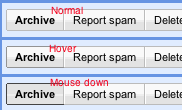
I was reading
Recreating the button,
Douglas Bowman's post on creating imageless buttons for GMail. It got me thinking,
how would I do that, you know, imageless buttons in YUI? Gmail & YUI, can I do that? It felt
a bit like dogs and cats, living together!
I was hoping for easy, easy, but it turned out to be tougher than I thought. Unless
I missed something big. Subclassing buttons in YUI isn't that easy, and YUI really
wanted to be based on a button or input tag. To work around all that I hacked together
a DivButton class, and then created a GmailButton subclass which sets up the imageless
div's like what's on Gmail. For your enjoyment, I give you:
Gmail Style Imageless Push Button
View the source on that file to see what a travesty I created. Probably not the best way
to do it, I admit it. But it mostly works. All disclaimers apply. Yes, I work for Yahoo! No,
not in the YUI group. And Yahoo! had nothing to do with this, except the YUI part of course.
I thought Google's imageless buttons were cool so I wanted to see how YUI would handle it.
As it turned out, not so well. If you see a better way to do this, please let me know!
Update: I realized after making the image of the button states, I hadn't accurately
reproduced the mouse-down state. I swapped the top and bottom colors, but it looks like
both should go to the darker shade of gray with the border remaining the same.
2008-06-15 09:14AM PDT/Home
Philip Aaronson
Happy Father's Day to all you Dads.
My kids served me breakfast in bed. This afternoon we've got back to back dance recitals, one for my middle daughter and then one for my older daughter. Four hours of little kids doing jazz and tap routines.
I'm wearing a Tinkerbell mouse-ear hat that my youngest insisted I wear. She's wearing a princess mouse-ear hat you see.
It all pretty much sums up Father's Day doesn't it?
2008-06-11 08:44PM PDT/Home
Philip Aaronson
I took a quick look at Caltrain's Bike Master Plan. The "plan" is a multi-page pdf file I'll summarize for you:
- No more space can and will be devoted to bikes even though demand currently exceeds supply.
- We'll be nicer to cyclists.
- We have to do something, lets put in more bike racks.
Okay, yes, I'm being bit snippy. There are some interesting tidbits hinting that perhaps they understand the underlying issues. Unfortunately they don't come out and state them. For example, under "Are We Doing Enough" they list:
- Real-time Information
- Demand Management
- Bike-sharing Program
- Folding Bike Subsidy
On any given day cyclists start lining up informally at stations. They don't know if there will be one or two bike cars on the coming train. They also don't know how full the bike cars already are. When the train arrives, they all have to file into any available spaces and that takes time. Caltrain lists 250 hours worth of delays attributed to bikes getting on and off the train.
The first two items are critical. They absolutely need to make real-time information about how many bike cars are on a train, and how full the car is available over the web. And at least have some mechanism in place for reserving a spot.
My suggestion for addressing the main issue of increasing bike carrying capacity which Caltrain ignores would be to eliminate designated bike cars, and simply go to a "cargo" area near the center of every car where the first two rows of seats are currently. This area would be designated for bikes, luggage, strollers etc. By having bikes load and unload all along the train, you reduce delays. It also makes the cars more uniform, so that emergency maintenance doesn't create a critical shortage of any particular type of car.
Getting even more inventive, there's a lot more available room on the train in the center "vestibule" if passengers load and unload on one side only. Once the station improvements are complete at Burlingame and California Ave, trains will no longer let passengers off into the center/opposite side of the car from the other stations. That's a lot of unused space in every entrance vestibule of every car. For safety reasons, obviously, you can't have bikes piled haphazardly and you need to have emergency egress. But I wonder if a portable rack couldn't be built to fit half of the unused side. When the train reaches the end, the racks could be slid to the opposite side of the car for the return trip.
If the portable vestibule rack could hold 2 bikes, and we could hold, say 4 bikes in what's the first two rows of seats. That's 10 bikes in every car except the handicap car and the bathroom car. But it significantly upgrades the carrying capacity of the train, decreases load/unload times and doesn't materially impact the carrying capacity of passengers.
Another alternative might be to install fold down seats so that the mix of passenger and bike carrying space could be more flexible. This is a solvable problem. I just wish Caltrain hadn't already made up their mind on this issue.
2008-06-11 08:24AM PDT/Home
Philip Aaronson
The other day I rode on over to OSH to pick up some parts to fix a leaky toilet. No one batted an eyelash at my cycling getup as I walked through the plumbing section. I was starting to think, damn, with high gas prices, this is the new normal. Could it be, could cycling be poised to go mainstream?
No, of course not: NYC Mayor: I'd Ban Bikes on Subways
Hearing that you're not welcome on the subway because you're carrying a bicycle is disappointing to say the least, especially since biking goes hand-in-hand with public transit. That's why cyclists in the Big Apple were outraged when Mayor Michael Bloomberg said that, if it were up to him, he'd ban bikes from trains.
Out here in California, Caltrain's bike cars are rapidly filling up. My wife recently got bumped, and it was the first time it happened to her on her run up to school at UCSF. Apparently this happens often on some of the more popular trains and they haven't figured something out yet. Leaving customers at the station is okay? Is it appropriate for a cyclist who has been waiting for the train longer than someone without a bike to be bumped and other not? I guess I should be happy they allow bikes at all.